
Modernizing Sprint Delivery
Agile and Lean frameworks were built to deliver speed, iteration accuracy. But the tools never kept up.

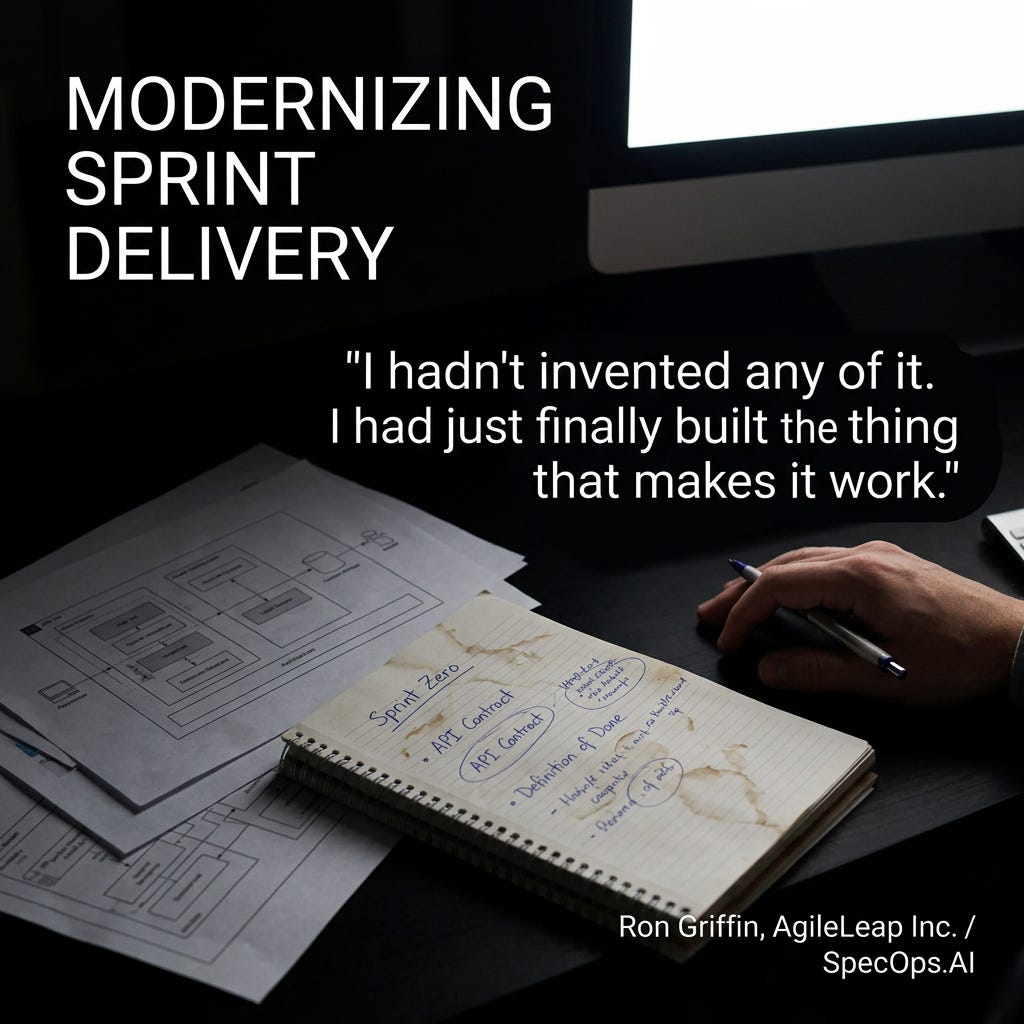
Issue - April 1, 2026 | Series: Modern Builder
Late that evening I looked at what I’d designed that day and felt something settle.
Not the relief of finishing something. The quieter thing. The thing that happens when you finally see what you’ve actually been doing for years without being able to name it.
I’d spent the morning designing a two-phase delivery architecture. Architecture sprint first. Build sprint second. Shared API contracts as the coordination layer. Milestone gates with binary success criteria. Definition of done at every boundary. I’d done all of this from instinct, from years of managing projects, applying frameworks, watching how delivery actually works versus how it’s supposed to work.
Then I looked at it again. And realized I hadn’t invented any of it.
I had just finally built the thing that makes it work.
The two-phase delivery plan I designed that morning was Program Increment Planning from SAFe. Except instead of sticky notes on a wall and a two-day ceremony that produces a wiki page nobody reads, it was a concrete deliverable with enforced boundaries and real accountability.
The architecture sprint was Sprint Zero. The foundational sprint Scrum has always called for that almost nobody executes properly because there’s no system to enforce it. Every time I’d tried to run one as a practitioner, it dissolved into a planning meeting that produced intentions instead of specifications.
The shared API contract as coordination layer was Scrum-of-Scrums. Except the synchronization point was the contract itself, not a weekly meeting where teams talked past each other and called it alignment.
The milestone gates with binary success criteria were Definition of Done. Elevated from a checklist someone updated in Confluence to a structural gate the system enforced automatically.
I’ve been an Agile practitioner for years. Managing projects. Facilitating sprints. Running program increments across enterprise engagements. The entire time I was working with tools I felt were fundamentally antiquated for what the frameworks were actually asking us to do. The principles were right. The tools couldn’t carry them.
Every sprint planning session that devolved into status updates. Every retrospective that produced action items nobody tracked. Every Program Increment that took longer to plan than to execute. Every milestone review that was a PowerPoint deck with optimistic green dots and no structural gate to prevent the next one from looking exactly the same.
The frameworks were always right. The technology underneath them was never adequate.
That night I understood what SpecOps.AI actually was in a way I hadn’t fully articulated before.
Sherpa isn’t just a code intelligence engine. Sherpa is the AI Scrum Master and CTO that every engineering team has been waiting for. The one that actually runs the sprint, tracks velocity, surfaces blockers, and nudges when things drift. Not because someone remembered to update the board. Because the system is watching and it cares about the outcome.
ORCHESTRATOR isn’t just a workflow engine. It’s the automation layer that makes CI/CD governance and deployment pipelines work the way SAFe always described and nobody could execute at speed without heroic manual effort.
OVERWATCH isn’t just monitoring. It’s the continuous improvement loop Agile has been promising since 2001. Constant feedback. Drift detection. Quality regression alerts. Running 24/7 without anyone having to schedule a retrospective to notice the problem had already happened.
I didn’t design a new methodology. I built the platform the existing ones always needed underneath them.
I didn’t design a new methodology. I built the platform the existing ones always needed underneath them.
I want to give credit where it’s owed.
Ken Schwaber and Jeff Sutherland created Scrum. Dean Leffingwell built SAFe. The Agile Manifesto signatories named principles that are right and have remained right. I’m not competing with any of them. I’m standing on what they built.
For years I watched those frameworks fall short in practice. Not because the ideas failed. Because the gap between what the ideas described and what the available tools could actually deliver was too wide for any Scrum Master or SAFe practitioner to close manually, no matter how skilled they were.
That evening, sitting with what I’d designed that day, the gap closed.
For anyone who has been in those rooms, facilitating those ceremonies, knowing the framework was right and feeling the tooling fail it repeatedly, I know what that means to feel.
If this was useful, forward it to one person building something.
Ron Griffin is CEO of AgileLeap Inc. and SpecOps.AI, building intelligent platforms for engineering teams, GovCon, and anyone serious about shipping something real. Writing weekly at @griffinbuilds on Substack.