


Issue — April 2, 2026 | Series: Modern Builder
The morning after I shipped the platform, I was a Modern Builder.
The morning after I sat with Mo, I was a founder.
There is a difference. And I did not fully understand it until I was sitting in that room.
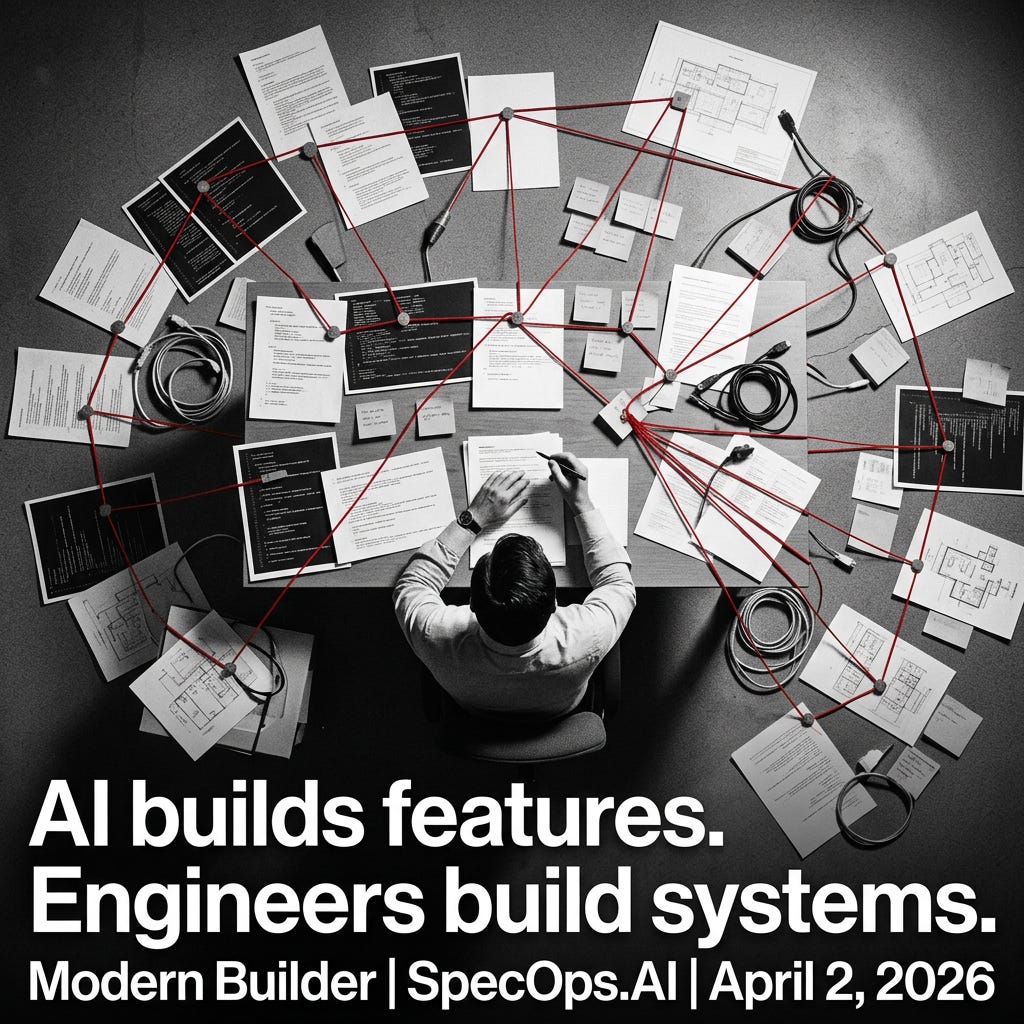
AI builds features. Engineers build systems. That difference becomes very real the morning after you ship.
I had shipped it. The sprint I wrote about last week. Working payments. Three portals. Auth. Compliance scoring. Stripe. The whole intelligence layer built and documented.
Sunday night I was on top of the world.
Monday morning I sat down with Mo.
He is the kind of engineer who has been in production environments when things break at 2am and has felt the pain that most vibe-coded platforms never encounter until they matter to real customers. He did not tear the work apart. He walked through the repo, calmly and methodically, and in under an hour he showed me what I could not see on my own.
What the architecture needed for blast radius management. Where a single failure could take down the entire system. Where the database schema needed segmentation I hadn’t thought to build. Where the AI had solved each task in isolation without accounting for how a Stripe webhook failure affects the context loader which affects the dashboard state.
I left that meeting humbled.
And deeply grateful. Because what happened in that conversation is exactly why we are building SpecOps.AI.
This is what engineers give you that AI cannot.
AI builds features. Engineers build systems.
Every task I gave the AI, it solved in isolation. Add Stripe. Done. Build the chat interface. Done. Create the compliance pipeline. Done. Each feature works. The happy path runs beautifully. But the AI was not thinking about how failures cascade across a system. An engineer who has lived through production sees the connections between everything and designs so that a failure in one place does not take down the whole.
AI generates code. It does not own consequences. When AI writes a database query, it is pattern-matching on what is correct for the task at hand. It is not thinking about what happens at 10,000 rows, or when two users hit the same endpoint simultaneously, or when an auth token expires mid-transaction. An engineer who owns a system builds defensively because they have felt the pain of those exact scenarios in production. That experience cannot be prompted into existence.
AI does not know what it does not know. And neither does the Modern Builder using it. When the AI told me something was done, I had no way to evaluate whether the solution was architecturally right or just functionally operational. Mo looked at the same code and saw structural issues immediately. Not because he is smarter. Because he has years of pattern recognition from systems breaking in ways the AI never anticipated.
That is what engineers bring. And it deserves to be said clearly: the engineers who know how to work alongside AI, who understand both the speed it creates and the gaps it leaves, are the most valuable people in modern software development. Mo is one of them. The Delta Dev standard was built to find more of them.
I want to say something carefully, because it is easy to misread this story.
None of this invalidates the build.
What I built in three days would have required a $200K seed round and six months of development five years ago. The Sherpa Score works. The compliance engine works. The portal architecture works. The patents are real. The platform is real.
What Mo gave me was the second half of the story. The part that turns a working product into a production system. The part that takes what a Modern Builder created from vision and instinct and prepares it for what happens when real customers arrive and real things break.
That conversation changed how I understood everything we are building.
SpecOps.AI is not competing with AI coding tools. We are the layer that sits between “I shipped it” and “it is actually ready.”
The Sherpa Score is Mo at scale. An experienced assessment of your codebase against your specific goals, compliance requirements, and growth trajectory. Not generic. Not punitive. Honest.
The Delta Dev standard exists because the conversation I had with Mo is the conversation every Modern Builder needs and almost no one gets access to. Engineers who have been in production. Who know what breaks. Who come in prepared to work with what was built, not to judge how it was built.
OVERWATCH is the monitoring that catches what you could not see while you were building too fast to look.
I needed all three. I got them through one honest conversation on a Monday morning.
The platform makes that conversation available to every Modern Builder who will never have a Mo walk in.
Builders ship things.
Modern Builders ship things that survive contact with the real world.
AI gave me the first morning.
An engineer gave me the second.
If this was useful, forward it to one person building something.
Ron Griffin is CEO of AgileLeap Inc. and SpecOps.AI, building intelligent platforms for engineering teams, GovCon, and anyone serious about shipping something real. Writing weekly at @griffinbuilds on Substack.